English
 русский
 Español
 عربى
عربى
What Materials Are Used in 3/4-Inch Brass Angle Valves?
The 3/4-inch brass angle valve is a ubiquitous component in residential and commercial plumbing systems. Typically found beneath sinks and toilets, and behind washing machines, these valves serve a crucial function: they provide a convenient point to shut off water supply to a specific fixture for maintenance or repair without disrupting water service to the entire building. The designation "3/4-inch" refers to the nominal size of the inlet and outlet connections, a common standard for supplying water to fixtures with higher demand, such as tankless toilets, some faucets, and appliances. While commonly called "brass valves," they are actually assemblies comprising several different materials, each selected for specific properties like corrosion resistance, machinability, sealing capability, and durability under pressure.
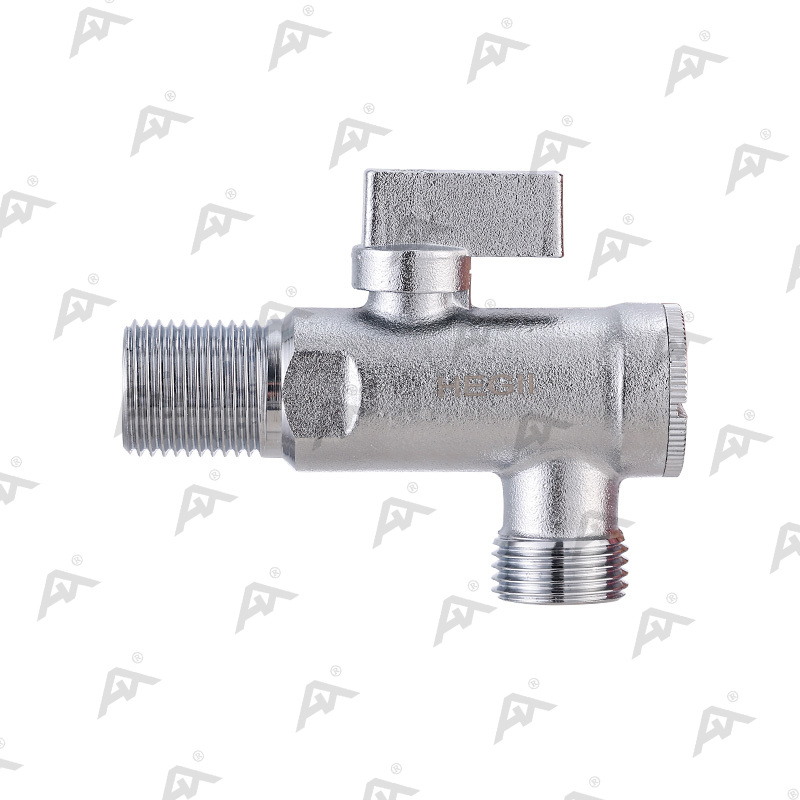
The Primary Body Material: Brass and Its Alloys
The main body of the valve, which contains the water passage and houses the internal components, is typically made from brass. Brass is an alloy of copper and zinc, and its specific formulation can vary depending on the manufacturing method and intended application.
Forged Brass: Many high-quality angle valves are manufactured using a forging process. A heated brass billet is placed in a die and subjected to high pressure, forcing the metal to flow into the shape of the valve body. Forging aligns the metal's grain structure, resulting in a denser, stronger, and more pressure-resistant component. Forged brass typically has a smoother surface finish and is less prone to porosity (tiny internal voids) than cast brass. The alloy used for forging often contains a higher copper content, which enhances corrosion resistance and machinability.
Cast Brass: Some angle valves, particularly economy models, are made through casting. Molten brass is poured into a mold, where it solidifies into the valve shape. Casting is a less expensive process than forging but can result in a component that is slightly less dense and more susceptible to porosity. Cast brass alloys may have different zinc-to-copper ratios and may include other elements like lead (historically) or bismuth and silicon (in modern lead-free formulations) to improve casting fluidity and machinability.
Lead-Free Brass: In many regions, plumbing codes now mandate that materials in contact with potable water must comply with lead-free standards (typically defined as containing less than 0.25% lead). This has led to the widespread adoption of lead-free brass alloys. These alloys replace lead with other elements, such as bismuth, silicon, or selenium, to maintain machinability while meeting the stringent lead content requirements. Lead-free brass is now the standard material for angle valves used in potable water applications.
DZR Brass: In areas with aggressive water chemistry (water that is soft or has a high chloride content), brass can be susceptible to a specific type of corrosion called dezincification. This process selectively leaches zinc from the alloy, leaving behind a weak, porous copper structure. For such environments, Dezincification Resistant (DZR) brass, also known as CR (Corrosion Resistant) brass, is specified. This alloy is treated or formulated to resist dezincification, ensuring long-term integrity of the valve body.
Internal Operating Components: The Stem and Ball
The internal mechanism that opens and closes the valve is typically either a compression stem or a quarter-turn ball. The materials for these components are chosen for their strength, wear resistance, and ability to form a watertight seal.
Brass Stem (Compression Valves): Traditional compression-style angle valves use a brass stem with a threaded portion. As the handle is turned, the stem screws into the valve body, moving a washer at its end onto a seat to stop water flow. The stem is typically machined from a free-machining brass rod. The threads must be precisely cut to ensure smooth operation and a positive shutoff.
Brass or Stainless Steel Ball (Quarter-Turn Valves): Modern quarter-turn angle valves use a ball with a hole through its center. When the handle is turned 90 degrees, the ball rotates, aligning the hole with the water passage to allow flow or presenting a solid face to block it. The ball is a critical component requiring high precision and surface finish. It is often made from chrome-plated brass. The chrome plating provides a hard, smooth, and corrosion-resistant surface that allows the ball to seal effectively against the valve seats with minimal operating torque. In some higher-end valves, the ball may be made from stainless steel for enhanced durability and corrosion resistance.
Stem Extension and Handle: The visible handle, attached to the stem or ball, is often made from cast or extruded aluminum, or from various plastics. Aluminum is lightweight, corrosion-resistant, and can be anodized in various colors for aesthetic appeal or coding (e.g., red for hot, blue for cold). Plastic handles are economical and provide good grip but may be less durable over long periods of UV exposure or heavy use.
Sealing Components: Ensuring a Drip-Free Operation
The ability of an angle valve to shut off water flow completely and to prevent leaks around the stem depends on a series of sealing components made from elastomeric and polymeric materials.
O-Rings: O-rings are circular seals made of elastomeric materials. They are used in several locations. In compression valves, an O-ring around the stem prevents water from leaking out along the threads when the valve is open. In quarter-turn valves, O-rings provide the primary seal between the rotating ball and the valve body, as well as sealing the stem. Common O-ring materials include:
Nitrile (Buna-N): A general-purpose rubber with good resistance to water, oils, and common chemicals. It is widely used in standard potable water applications.
EPDM (Ethylene Propylene Diene Monomer): Offers resistance to hot water, steam, and weathering. It is often preferred for applications involving higher temperatures. It is important to note that EPDM is not compatible with petroleum-based oils or greases.
Viton (FKM): A high-performance fluorocarbon rubber with exceptional resistance to high temperatures and a wide range of chemicals. It is used in more demanding applications.
Valve Seats: The stationary surface against which the ball or washer seals is called the seat. In many brass angle valves, the seats are integral to the valve body, meaning the brass itself provides the sealing surface. However, in some designs, separate seat rings made of materials like PTFE (Teflon) or reinforced nylon are used. These polymeric seats offer a lower friction surface, ensuring smooth operation and a tight seal with less required torque.
Compression Washer: In traditional compression valves, a rubber or fiber washer is attached to the end of the stem. When the valve is closed, this washer is compressed against the seat inside the valve body, blocking water flow. These washers are typically made from a durable rubber compound, similar to O-ring materials, and are designed to be replaceable when they wear out over time.
Connecting Components: Nuts, Sleeves, and Supply Lines
The 3/4-inch angle valve must connect to the plumbing system, typically to a rigid pipe stub-out from the wall and to a flexible supply line bring about the fixture. These connections involve several additional components made from specific materials.
Compression Nuts and Sleeves (Ferrules): The common method for connecting the valve to a rigid copper pipe is a compression fitting. This consists of a brass compression nut and a small brass ring called a ferrule or olive. The nut is threaded onto the valve body, and as it is tightened, it compresses the ferrule around the copper pipe, creating a watertight seal. Both the nut and ferrule are typically made of brass for corrosion resistance and to prevent galling (seizing) between the nut and the valve body threads.
Supply Line Connections: The outlet of the angle valve is typically threaded to accept a flexible supply line. These lines often have a pre-attached nut and a cone-shaped washer. The nut is usually plated steel or brass, and the washer is made of rubber or nylon. The flexible line itself may be braided stainless steel over a PTFE or rubber core, or it may be a corrugated polymer. The materials for these lines are chosen for their flexibility, pressure rating, and corrosion resistance.
Solder Joints: In some installations, particularly in older homes or in areas where compression fittings are not preferred, the valve may have a solder-type inlet connection. In this case, the valve body is made with a cup that accepts the copper pipe, and the joint is made permanent by soldering. This requires that the valve body material (brass) be compatible with the soldering process and that the alloy can withstand the heat without damage.
Conact Us Anytime.
-
Email us
kyoda@kyodavalve.com
-
Call us
+86-19105861791