English
 русский
 Español
 عربى
عربى
What are the common failure modes of brass check valves and how can they be identified?
Leakage in the closed position (reverse flow)
This occurs when the sealing surface fails to achieve complete shut-off. Observable symptoms include pressure gauge fluctuation on the downstream side (pressure rising slowly when upstream pressure is lower) or audible hissing in gas systems.
Seat debris: Hard particles (sand, scale, pipe dope) lodge between the disc and seat. For a ¾-inch valve, a particle as small as 0.5 mm creates a leak path of 1–3% of fully open flow. Correction: disassemble the valve and clean the seat with a brass brush. Installation of a Y-strainer (40 mesh or finer) upstream prevents recurrence.
Worn or eroded seat: After 10–15 years in hot water systems (60–85°C), brass seats undergo dezincification—zinc leaches out, leaving porous copper. Leakage increases gradually, reaching 5–10% of forward flow by the year. Replace the valve; dezincification-resistant brass (DZR, with arsenic or antimony addition) extends life to 20–25 years.
Damaged disc or poppet: Rubber or PTFE discs harden with heat and chlorine. At water temperatures above 70°C, Buna-N discs lose elasticity after 3–5 years; EPDM discs last 8–12 years. Hardened discs cannot conform to seat irregularities, causing leakage. Inspection involves removing the disc and pressing a fingernail into the sealing surface—if no indentation remains, the material has hardened and requires replacement.
Failure to open (no forward flow)
Disc or ball stuck in closed position: Corrosion products (verdigris, a green patina of copper carbonate) build up around the hinge pin or ball guide. In systems with infrequent flow (e.g., seasonal irrigation), valves left closed for 6 months may seize. Apply penetrating oil (WD-40 or similar) to the hinge area; if the valve remains stuck, replace the internal components. Prevent by cycling the valve manually (if design allows) or installing a valve with a non-stick coating (e.g., PTFE-impregnated disc).
Spring failure (spring-loaded types): The spring may break due to cyclic fatigue. A typical spring rated for 100,000 cycles fails at 80,000–150,000 cycles, depending on water quality. A broken spring causes the poppet to remain seated regardless of pressure. Diagnosis: remove the spring and check for fractures; replacement springs cost $2–8.
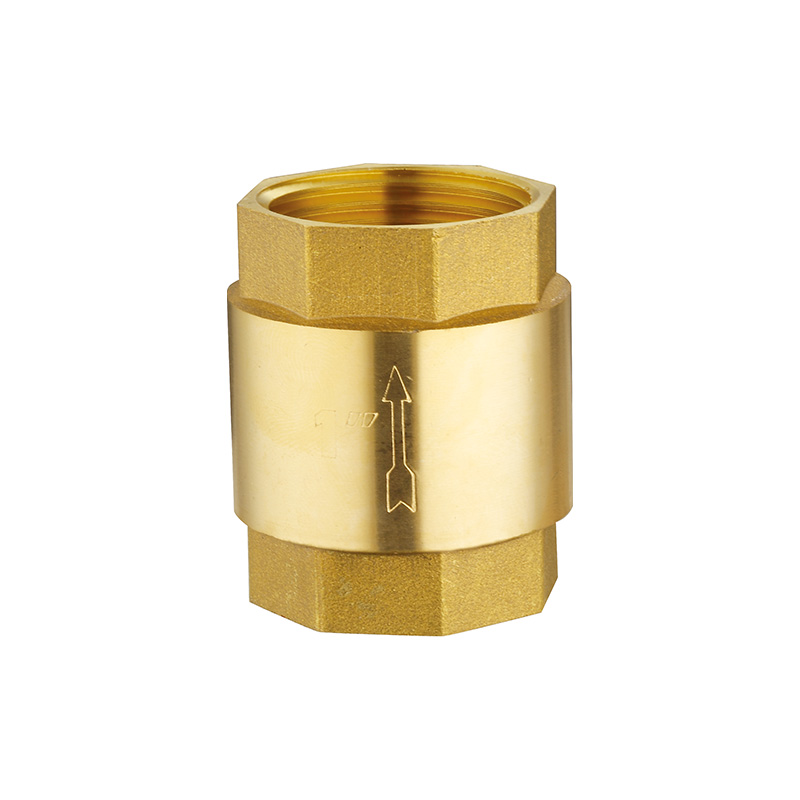
Reverse installation: Approximately 15% of field failures trace to the valve being installed backwards. Arrow markings on the body indicate flow direction. Correction: Reinstall correctly. No permanent damage occurs if the valve was not operated under high reverse pressure.
Chattering or hammering noise
Rapid cycling of disc or ball: Occurs when flow velocity fluctuates near the valve’s closing threshold. Common in systems with variable-speed pumps or at low flow rates (below 20% of valve's rated capacity). Solution: Replace the valve with a spring-loaded silent check valve designed for low-flow stability, or adjust the system to maintain a minimum flow above 0.5 m/s.
Loose hinge pin (swing checks): The pin holding the disc becomes loose after 8–12 years of operation. The disc vibrates against the seat, producing a repetitive tapping sound at 10–30 Hz. Tightening or replacing the pin requires disassembly. If the valve body is worn around the pin bore, replace the entire valve.
How does water quality affect the service life of brass check valves?
Three water quality parameters significantly influence brass check valve lifespan.
Chlorine concentration: Municipal water supplies contain 0.5–4.0 ppm free chlorine for disinfection. Chlorine reacts with the zinc component of brass, causing dezincification. At 2.0 ppm chlorine and a water temperature of 60°C, the corrosion rate of standard C37700 brass is 0.08–0.12 mm per year. A valve body with 2 mm wall thickness loses structural integrity after 15–20 years. DZR brass reduces this rate to 0.01–0.03 mm per year, extending life to 40–60 years. For swimming pool applications with 1–3 ppm chlorine and temperatures of 25–30°C, standard brass valves fail in 5–8 years; DZR brass lasts 15–20 years.
pH range: Brass is stable in water with a pH of 6.5–8. Below pH 6.0 (acidic well water or condensate), dezincification accelerates 4–6 times. At pH 5.0, corrosion rate reaches 0.3–0.5 mm per year. A valve in acidic service may develop through-wall pitting within 2–3 years. Above pH 9.0 (alkaline boiler feedwater or certain industrial processes), brass becomes susceptible to stress corrosion cracking, especially if residual stresses from manufacturing exceed 30% of yield strength.
Dissolved solids and sediment: Water with total dissolved solids above 500 mg/L (moderately hard to hard water) deposits calcium carbonate scale on valve seats. Scale buildup of 0.5 mm thickness prevents proper sealing, causing leakage rates of 2–5% of full flow. Quarterly inspection of valves in hard water applications is recommended. Sediment (sand, iron particles from old pipes) larger than 0.3 mm abrades the sealing surface. A brass check valve exposed to sediment at a 50 mg/L concentration shows a seat wear depth of 0.1–0.2 mm per 1,000 operating hours. Installing a 100-mesh strainer upstream reduces wear by 70–80%.
What installation practices maximise the reliability of brass check valves?
Orientation requirements:
Swing check valves: Install in horizontal piping with the hinge pin horizontal and disc opening upward. Vertical installation requires flow moving upward; downward flow prevents disc closure. Allow 5–10 pipe diameters of straight pipe upstream to avoid turbulence affecting disc operation.
Spring-loaded poppet valves: Universal orientation. Upside-down installation does not affect the function. However, the spring should be inspected for sag after 5 years in vertical installations where the poppet weight adds to spring load.
Ball check valves: Horizontal or vertical-upward only. In vertical-downward orientation, the ball may not lift off the seat at low flow rates because gravity pulls it downward against the flow direction.
Distance from flow disturbances: Place the check valve at least 10 pipe diameters downstream of elbows, tees, or pumps. Turbulent flow within 5 diameters of a swing check causes disc flutter, reducing seat life by 50–70%. For a 1-inch valve (25 mm nominal), maintain 250 mm (10 inches) of straight pipe upstream. In tight spaces, use a spring-loaded check valve, which is less sensitive to turbulence.
Conact Us Anytime.
-
Email us
kyoda@kyodavalve.com
-
Call us
+86-19105861791